Search is changing. Is your digital strategy changing with it?
There was a time when digital visibility meant one thing:
Get your website on the first page of Google.
Today, the search landscape looks very different.
People are no longer relying only on traditional search results. They are asking questions directly to AI tools, exploring conversational search experiences, watching videos, using visual search, and expecting instant, relevant answers.
And this is where three important terms have entered the digital marketing conversation:
SEO. GEO. AEO.
They may sound similar, but each focuses on a different aspect of modern search visibility.
So, what exactly do they mean—and how should businesses approach them in 2026?
Let’s break it down.
🔍 First Things First: What Is SEO?
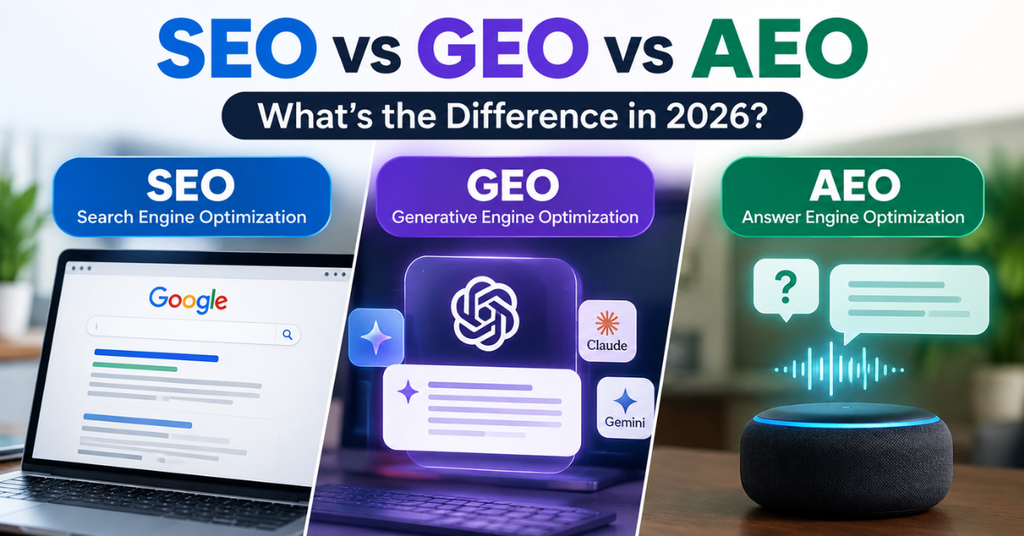
SEO = Search Engine Optimization
SEO is the process of improving your website and content so search engines can understand, discover, and rank your pages for relevant searches.
Traditional SEO focuses on areas such as:
- Keyword research
- Search intent
- Technical SEO
- Website structure
- Quality content
- Internal linking
- Backlinks and authority
- Local SEO
- User experience
The objective?
Be visible when your audience is searching.
For example, if someone searches:
“Best digital marketing agency in Delhi”
an SEO strategy aims to help relevant agency websites appear prominently in those search results.
But here’s the important part:
SEO isn’t disappearing because AI is growing.
Google’s current guidance continues to emphasize established SEO fundamentals for its AI-powered search experiences. In other words, businesses shouldn’t throw away SEO—they should evolve their approach alongside search.
Think of SEO as your digital foundation.
🤖 Now Comes GEO
What Is GEO?
GEO = Generative Engine Optimization
GEO is a newer concept focused on improving the chances of your brand, website, expertise, or content being referenced within AI-generated responses.
Imagine someone asks an AI system:
“What should a startup look for when choosing a digital marketing agency?”
Instead of receiving ten blue links, the user may receive a generated response that summarizes information from multiple sources.
The opportunity for brands changes.
You don’t just want someone to click your website.
You want your brand to become part of the information ecosystem that AI uses to formulate answers.
GEO therefore places greater emphasis on things such as:
- Original insights
- Clear and authoritative information
- Strong topical relevance
- Trustworthy sources
- Brand mentions
- Demonstrated expertise
- Well-structured content
However, GEO is still an evolving field.
There is no guaranteed formula that makes a website appear in every AI-generated response.
The goal isn’t to “hack” AI. It’s to become a credible source worth referencing.
💡 And Then There’s AEO
What Is AEO?
AEO = Answer Engine Optimization
AEO focuses on creating content that can effectively answer the questions people ask search engines and answer-driven platforms.
Think about the difference.
Traditional SEO might target:
“Digital marketing agency Delhi”
AEO might target questions such as:
“How much does digital marketing cost for a small business?”
or
“How long does SEO take to generate results?”
The content needs to provide a clear, useful, and direct answer.
AEO commonly involves:
- Question-focused content
- Clear headings
- Concise explanations
- FAQ sections
- Structured content
- Relevant context
- Helpful examples
- Trustworthy information
The objective is simple:
Don’t just help people find your content. Help them find the answer.
⚡ SEO vs GEO vs AEO
Here’s the easiest way to understand the difference:
| SEO | GEO | AEO |
|---|---|---|
| Search Engine Optimization | Generative Engine Optimization | Answer Engine Optimization |
| Focuses on search visibility | Focuses on AI-generated discovery | Focuses on direct answers |
| Helps pages rank in search | Helps brands become sources in AI responses | Helps content answer specific questions |
| Keyword + intent focused | Authority + context focused | Question + answer focused |
| Traditional search foundation | Emerging AI-search approach | Answer-focused approach |
But here’s where things get interesting.
You Don’t Have to Choose One.
SEO, GEO, and AEO can work together.
🌐 The New Search Journey
Imagine a customer looking for a digital marketing agency.
Their journey could look something like this:
Google Search
↓
AI-generated overview
↓
Agency website
↓
Instagram / LinkedIn
↓
Reviews & reputation
↓
Case studies
↓
Contact
The customer doesn’t necessarily follow one straight path anymore.
They may discover a brand through search, validate it through social media, ask an AI tool about it, read reviews, and then visit the website.
Search has become an ecosystem—not just a results page.
And that changes how brands should think about digital marketing.
🚀 How Should Businesses Adapt in 2026?
01 — Create Content People Actually Want
Stop creating content simply because a keyword has search volume.
Instead, ask:
What does my audience actually want to know?
Create content that answers genuine questions, solves problems, provides examples, and demonstrates expertise.
02 — Build Topical Authority
One random blog post isn’t enough to establish expertise.
Build connected content around your key subjects.
For a digital marketing agency, that could look like:
SEO
→ Technical SEO
→ Local SEO
→ Content SEO
→ AI Search
→ GEO
→ AEO
This creates a deeper content ecosystem around your expertise.
03 — Make Your Content Easy to Understand
Great content doesn’t need complicated language.
Use:
Short paragraphs.
Clear headings.
Useful examples.
Bullet points.
FAQs.
Data where relevant.
Make your content easy for both people and search systems to understand.
04 — Build Brand Authority Beyond Your Website
Your website isn’t the only place where your brand exists.
Think about:
- Industry publications
- Reviews
- Social media
- Expert interviews
- Partnerships
- Digital PR
- Thought leadership
- Relevant third-party mentions
The stronger your overall digital presence becomes, the more opportunities you create for people—and digital systems—to understand your brand.
🎯 So, Which One Should You Focus On?
The answer isn’t:
SEO OR GEO OR AEO.
Instead, think:
SEO + GEO + AEO
SEO helps establish your foundation.
GEO helps you think about visibility within emerging AI-driven discovery.
AEO helps you structure content around the questions your audience is asking.
Together, they create a broader approach to modern search visibility.
🔮 The Future of Search Isn’t Just About Rankings
The biggest change in digital marketing isn’t simply that AI is becoming part of search.
It’s that discovery itself is changing.
People want faster answers.
They want relevant recommendations.
They want trustworthy information.
And they increasingly expect technology to understand the context behind their questions.
For brands, that means the old question:
“How do I rank #1?”
is becoming just one part of a much bigger question:
“How do I make my brand discoverable wherever my audience is looking for answers?”
That’s the mindset businesses need in 2026.
💙 TheDigitalStrategia Perspective
At TheDigitalStrategia, we believe modern digital marketing isn’t about chasing every new buzzword.
It’s about understanding where your audience is going, how they discover information, and what makes them trust a brand.
SEO. GEO. AEO.
Different approaches.
One bigger objective:
Make your brand easier to discover, understand, trust, and choose.
Because in the new era of search,
**Visibility gets attention.
Authority builds trust.
Strategy drives growth.**
TheDigitalStrategia — Don’t Just Market. Strategize.